How Aquatic Therapy Speeds Up Joint Replacement and ACL Surgery Recovery
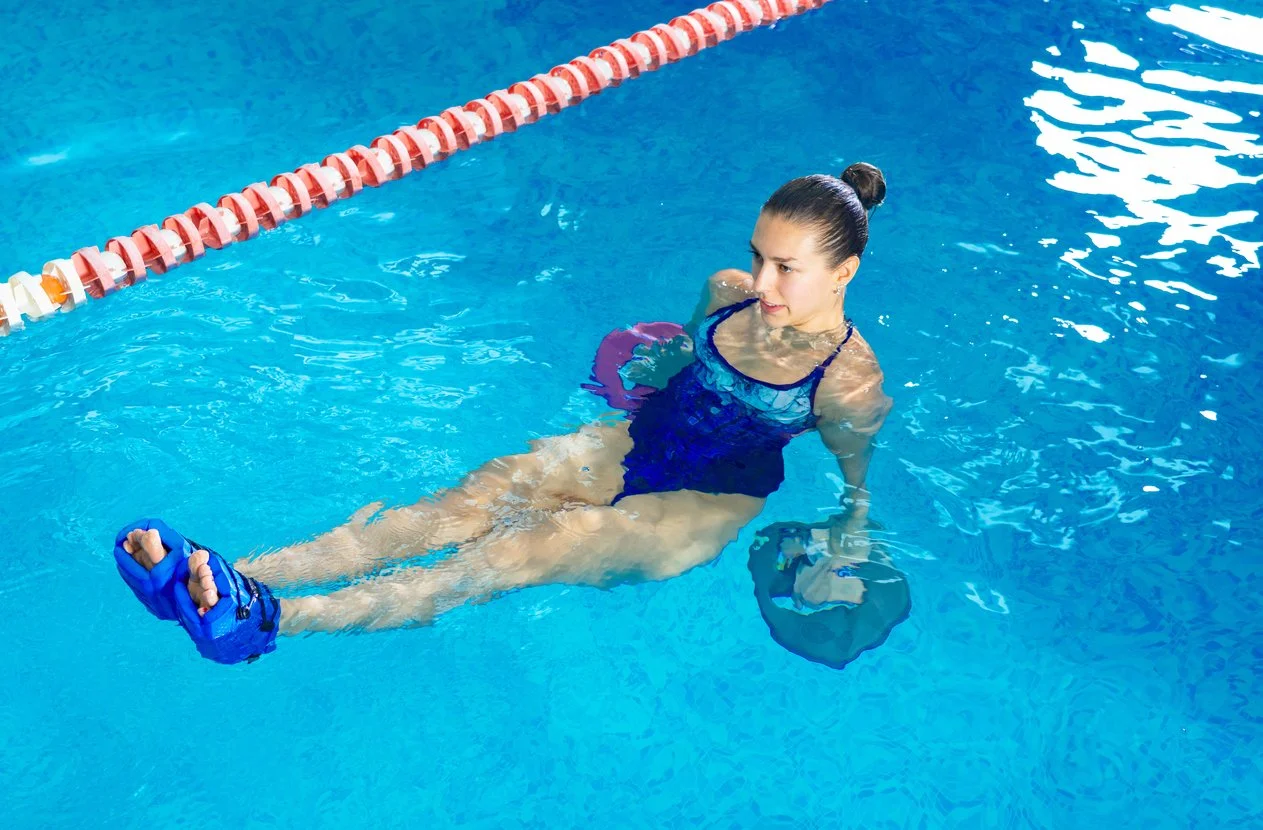
Early, controlled movement after orthopedic surgery helps limit scar tissue adhesion and joint stiffness. Prolonged immobility works against you.
Warm water reduces protective muscle guarding, allowing a safer and often larger range of motion than the same exercise performed on land.
Buoyancy lets you begin weight-bearing gait retraining earlier and with far less compressive load on the healing joint.
A typical progression moves from submerged walking and range of motion work, to resisted leg movements, to balance and single-leg control.
Our aquatic therapy complements your surgeon's protocol. It does not replace it, and you need medical clearance and a fully closed incision before entering the water.
Total knee replacement, total hip replacement and ACL reconstruction all share the same recovery paradox. The joint needs rest to heal, and it needs movement to heal well. Get that balance wrong in either direction and you end up with a stiff, weak, poorly functioning limb.
Aquatic physical therapy is rehabilitation performed in a heated pool, using buoyancy, water resistance and hydrostatic pressure to make therapeutic movement safer and more tolerable. For the post-surgical patients we work with every day, it solves that paradox by letting you move meaningfully while the joint is still too fragile for full land loading.
Why Early Movement Matters After Surgery
When a joint stays stationary after surgery, several things happen quickly, and none of them are good.
Scar tissue adhesion. Collagen laid down during healing organizes along the lines of stress placed on it. Without movement, it forms a disorganized web that physically restricts the joint.
Arthrofibrosis and stiffness. Excessive scar tissue inside and around a replaced knee or reconstructed ACL can permanently limit flexion and extension, and sometimes requires a second procedure to correct.
Muscle atrophy. The quadriceps in particular shut down rapidly after knee surgery. Strength loss compounds within days, not weeks.
Circulatory risk. Immobility after lower limb surgery is associated with increased clot risk, which is why surgeons push so hard for early mobilization.
Persistent swelling. Static limbs accumulate fluid, and swelling itself inhibits muscle activation and joint range.
The problem is that early land-based movement is often intolerable. The joint hurts, you are understandably fearful, and the compressive load is significant. Water resolves that tension, which is why so many orthopedic teams in our area refer patients to us. We also encourage clients to review patient education resources from the American Academy of Orthopaedic Surgeons alongside their own surgeon's instructions.
The Warm Water Advantage: Relaxing Guarded Muscles
Post-surgical patients guard. Your nervous system protects an injured area by holding the surrounding musculature in a state of low-grade contraction, and that guarding is one of the main reasons range of motion stalls.
Therapeutic pools are kept warmer than a standard lap pool, typically between 88 and 94 degrees Fahrenheit. That thermal environment does several things at once:
Reduces muscle guarding. Warmth encourages muscular relaxation, so we can move the joint through a greater arc before protective tension limits it.
Improves tissue extensibility. Warm connective tissue stretches more readily and with less risk of irritation.
Modulates pain perception. Immersion provides constant sensory input across the skin, which competes with pain signaling and makes the same movement feel less threatening.
Reduces anxiety. Fear of movement is a genuine clinical barrier after surgery. Our clients almost universally report feeling safer in water.
Combine that with buoyancy, and a patient who can barely tolerate a partial squat on land can often perform a controlled, full-range movement in our hydrotherapy pool.
Land-Based vs. Aquatic Post-Surgical Rehabilitation
| Consideration | Aquatic Therapy | Land-Based Therapy |
|---|---|---|
| Joint compression | Greatly reduced by buoyancy | Full or partial body weight |
| Typical pain during exercise | Lower, warmth and support reduce guarding | Higher in early stages |
| Earliest safe start | Once incision is fully closed and cleared | Often immediately, with restrictions |
| Swelling control | Assisted by hydrostatic pressure | Requires ice, elevation, compression |
| Fall risk during gait retraining | Very low | Moderate, especially with weakness |
| Loading for bone and tendon adaptation | Limited, by design | Essential in later stages |
| Best role in recovery | Early and mid-stage bridge | Mid and late-stage strengthening |
A Sample Week-by-Week Rehabilitation Progression
The following is illustrative only. Your actual program depends on your procedure, your surgeon's protocol, your tissue healing and our assessment of you.
Weeks 1 to 2 (Land Phase, No Water)
Incision care, swelling management, gentle range of motion and muscle activation as directed by your surgical team. Do not enter a pool until the wound is fully closed and you have explicit clearance.
Weeks 2 to 4: Reintroducing Movement
Chest-deep walking forward and backward, focusing on restoring a normal heel-to-toe gait pattern
Gentle assisted knee or hip flexion and extension, using buoyancy to support the limb
Supported weight shifting side to side
Short sessions, often 15 to 20 minutes, prioritizing quality over duration
Weeks 4 to 8: Building Controlled Strength
Water-drag leg extensions and hamstring curls, where resistance rises with the speed you move
Lateral stepping and cross-over walking for hip abductor and adductor control
Mini squats to a pain-free depth in chest-deep water
Longer continuous walking intervals to rebuild cardiovascular capacity
Weeks 8 to 12: Balance, Control and Transition
Single-leg stance work with progressively reduced hand support
Step-ups and controlled directional changes
Progression into shallower water to gradually reintroduce body weight loading
Increasing overlap with land-based strengthening
Different procedures call for different emphases. Our total knee joint treatment program concentrates heavily on regaining terminal extension and flexion range, while our total hip replacement treatment respects precautions around hip flexion, adduction and rotation in the early months. Reconstruction cases follow a different arc again, with graft protection dictating the pace of your aquatic therapy progression.
Frequently Asked Questions
When can I start aquatic therapy after knee replacement surgery?
Most of our clients begin between two and six weeks post-operatively, but only once the surgical incision is completely closed and dry, and only with clearance from the operating surgeon. Entering a pool with an unhealed wound creates a serious infection risk.
Does aquatic therapy replace conventional physical therapy?
No. It is a complement. Water is exceptional for early range of motion, gait retraining and pain-free movement, but rebuilding full strength, bone loading and land-based function still requires work outside the pool. Most of our clients do both.
Is hydrotherapy effective for ACL recovery specifically?
Yes, particularly in the early and middle phases. It allows gait normalization, quadriceps activation and controlled range of motion while protecting the healing graft from excessive load. We introduce it alongside, not instead of, your standard land-based ACL protocol.
Do I need a physician referral?
Requirements vary by insurer and by state regulations, so contact us and we will walk you through what applies to your situation. Either way, post-surgical patients should always confirm with their surgeon before beginning any new rehabilitation modality.